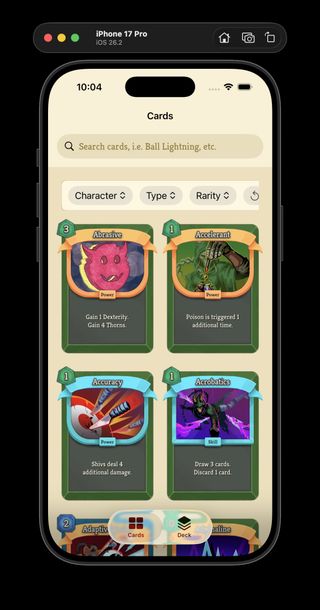
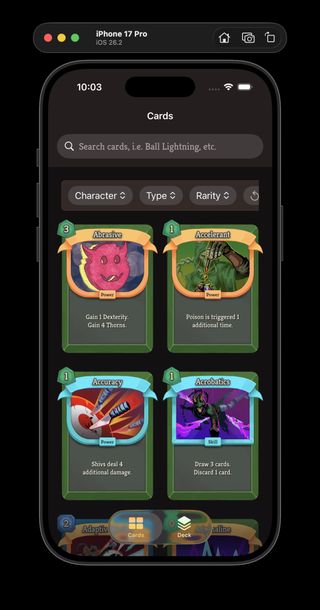
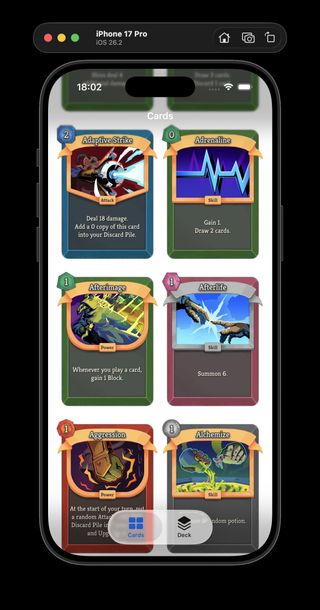
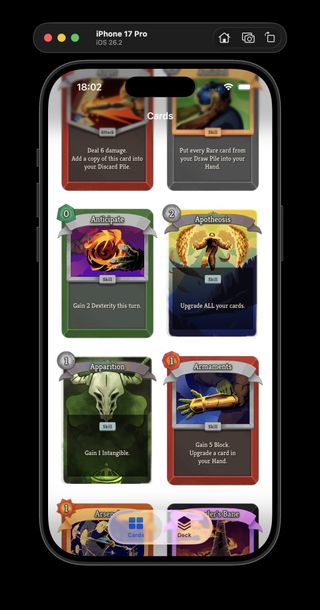
Neow's Cafe with the new light and dark app themes side by side.
I shipped another Neow's Cafe UI pass in ProjectSpire, focused on turning the app's visual styling into reusable systems instead of one-off view code. The work in the May 7 snapshot registers the app fonts as a typography system so I can use consistent text styles anywhere in SwiftUI, and adds explicit light and dark themes for the card catalog UI. It is a small-looking change, but it gives the app a much cleaner foundation for future screens.
It uses ProjectSpire as the working example: instructions as project memory, plans for intent, Captain Logs for collaboration taste, devlogs for technical history, and skills or workflows for repeated mechanical steps.
The useful idea is that the repo should accumulate context as it is used, so the human still supplies the judgment, but the surrounding system gets better at carrying that judgment forward.
I shipped v1.33.0 of 11ty-subspace-builder, adding wrap toggles to Markdown code blocks and GitHub embeds. Markdown code blocks now wrap by default, including Markdown files rendered through GitHub embeds, while collapsed GitHub embeds still allow long lines to scroll horizontally. I also added a draft regression page for long GitHub and Markdown code lines so this behavior has a concrete page to test against.
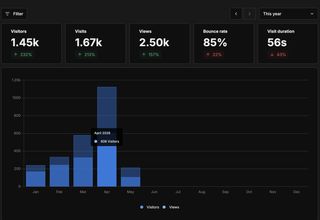
April 2026 blog traffic: 606 visitors and roughly 1.13k views.
I was surprised to find out that my blog traffic has been growing organically, with no marketing from me at all. Last month it had 606 visitors and roughly 1.13k views, which is a real WOAH moment for a personal site. Thanks to everyone who has been coming to my blog; I wish you all the best.
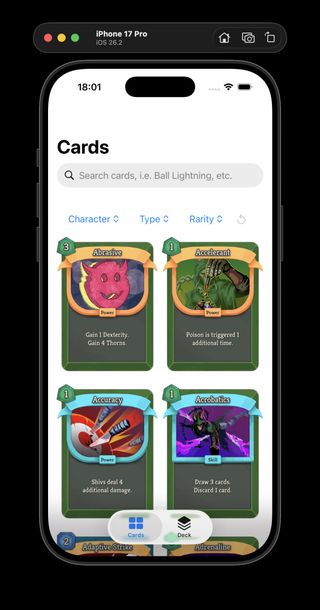
Neow's Cafe browsing catalog-backed card data instead of bundled mock cards.
I spent today turning ProjectSpire's iOS app "Neow's Cafe" from a mock-card browser into something much closer to a real Slay the Spire 2 card catalog.
The main decision was to keep the first version boring in the best way: a static, versioned catalog generated from the game data, served locally, and loaded directly by the app instead of inventing a REST API too early.
That structure gave the app one small index for browsing and filtering, while keeping full per-card files and portrait assets nearby for detail/debug views later. The important bit is that the card grid does not need to fetch hundreds of separate files just to show the collection.
		`cards.index.json` is the grid, search, and filter payload. It contains all card summaries needed by the app:

- id
- slug
- title
- description
- energy cost
- type
- rarity
- pool
- portrait path
- optional detail path

Keep individual card JSON files for detail and debug views, not for the main grid.
On the Swift side, CardCatalogService.swift now loads manifest.json, follows it to cards.index.json, and decodes the catalog into app cards. I also removed the old bundled sample portraits, so the app is now much more dependent on the generated catalog behaving like the source of truth.
The Cards screen got some polish too: the catalog can be refreshed from the view, the grid is now a two-column layout that preserves the card aspect ratio in CardsView.swift, and I cleaned up the filter model so "no filter" is represented by optional UI state instead of fake .all enum cases (filter cleanup commit).
The other nice bit from today is process-oriented: ProjectSpire now has Captain Logs for collaboration notes and a reusable workflow for turning a day's commits and documentation changes into these timeline summaries. That should make it easier to keep writing about the work without having to rediscover the shape of the day from raw git history every time.
After a few weeks working on ProjectSpire with Codex, I’m leaning toward it as my default for software engineering projects. The main frustration has been hitting the Pro account limit; otherwise the quality has been good, the interaction feels responsive, and the output gives me instant feedback while it works. Claude Code still feels more like a black box to me: it can disappear into minutes of research and thinking on its own, and the effective limit feels lower. That tradeoff matters, because for this kind of project I want a tight engineering loop more than a long silent reasoning pass.
Shipped Card Parser v0.2.3 to ProjectSpire, which adds calculated variable resolution, numeric symbol extraction, and conditional text formatters. Cards like Ashen Strike now show computed damage values instead of raw placeholders, and I've added choose, cond, inverseDiff, and boolean formatters for rendering conditional card text. The parser now threads card type, target type, and runtime display vars (HasRider, Sapping, Energized, etc.) through text resolution, making the pipeline much more precise about card state and context.
The whole card parser has been built in this mode: I act as architect, GPT-5.5 acts as developer. Every meaningful parser improvement came from me inspecting concrete generated JSON against real card examples and asking source-fidelity questions. GPT-5.5 didn't discover that cost upgrades can be negative, or that Bash's upgraded Vulnerable value wasn't being applied, or that X-cost cards needed their own shape. I did, by reading the output and comparing it to what the game actually does.
The pattern that emerged: I'd spot a class of issue on a specific card, explain what the game source was doing and why the output was wrong, and GPT-5.5 would produce a working fix. Then I'd push to turn each discovery into a repeatable check rather than a one-off patch. The coverage audit script, the unresolved placeholder CSV, the hard failures on missing source files: all of those came from me steering toward systemic fixes after catching individual bugs.
What GPT-5.5 is good at in this loop is the mechanical throughput. Regex extraction, threading new state through a resolution pipeline, mirroring changes to the audit script, regenerating 55 JSON files, splitting work into clean commits. The domain knowledge, the quality bar, and the architectural decisions all come from the human side. GPT-5.5 doesn't know what CalculatedVar means in the game engine or why display vars like HasRider matter for conditional text. It doesn't need to, once I describe the shape of the problem clearly enough.
The productivity gain isn't just speed. It's that I can stay at the architectural level, thinking about which cards are still wrong and why, without losing momentum to implementation mechanics. The feedback loop stays tight: inspect, identify, describe, implement, verify, repeat.
Here's what a fully resolved card looks like now. Ball Lightning's resolved block shows the base and upgraded display states, with structured text runs that carry source variable references and style annotations:
I shipped v1.32.1 of 11ty-subspace-builder to fix prose link wrapping on narrow screens. Very long URLs now wrap inside the content column instead of forcing the page wider than the mobile viewport, which keeps notes and posts readable even when a raw link has nowhere graceful to break.
I worked with GPT-5.5 on a reproducible Slay the Spire 2 resource extraction plan and then landed it in ProjectSpire across the recovery scripts, allowlist, generated resource subset, image-format experiment, and workflow docs.
The Principles matter more than the files: keep the full recovered dump local and ignored, track only curated resources with a current use, make extraction scriptable instead of manual, prefer readable Python tooling, keep binary assets repo-friendly with WebP and Git LFS, and write down the decisions close to the evidence.
The implementation follows that shape by keeping Lab/unpacked/ as the local source dump and generating Lab/resources/ from Lab/resources.allowlist.yaml, starting with localization plus WebP q85 card portraits.
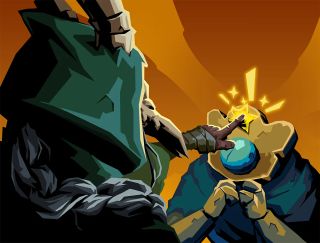
That gives my STS2 projects inside the ProjectSpire monorepo access to assets like this at roughly a fraction of the original size, around 10%, without needing to commit the full recovered dump.
One of the recovered card portraits from the first curated resource subset.
I shipped generated Open Graph cards for the timeline in v1.32.0 of 11ty-subspace-builder. The root timeline page and individual timeline entries now get social preview images from generated card data, while static card metadata lives in site data so downstream projects can configure it without touching templates. I also updated the timeline docs to spell out how those preview images are selected.
I added a ProjectSpire design note in 399f74d that pushes the card pipeline toward a two-pass model: keep the parser output source-faithful, then resolve localization and rendered text separately for the app.
I created that work with GPT-5.5 in plan mode, and it asked a few genuinely useful clarification questions before I let it draft anything substantial, which made the whole process feel a lot more controlled than a blind codegen pass. I also pushed back on several of its first suggestions and made a lot of the consequential decisions myself, especially around keeping canonical variable names intact and separating raw data from resolved display data. That feels like a strong pattern for future ProjectSpire work: use the AI models to widen the search space, but keep the architecture decisions and edits grounded in my own judgment.
I published Slip, Slop, Slap vs. Going Pink: Why Australia and the UK Treat Sun Safety So Differently, a note on why Australia and the UK treat sun safety so differently and why the mortality numbers are more surprising than the incidence numbers. The observations are mine; AI handled the research and wrote the first draft, and I edited the result before publishing.