I released v1.15.0 of my skills. engineering-standards now asks for explicit argument labels and gains semantic code layout conventions, covering declaration ordering, enum projections and multiline Swift layout, in a new references/layout.md. wrap-up can now resume from HANDOFF.md after a clear, so the next session picks up the parked context instead of me pasting it back in. The Swift examples in behavior-tests are now generic rather than tied to one app.
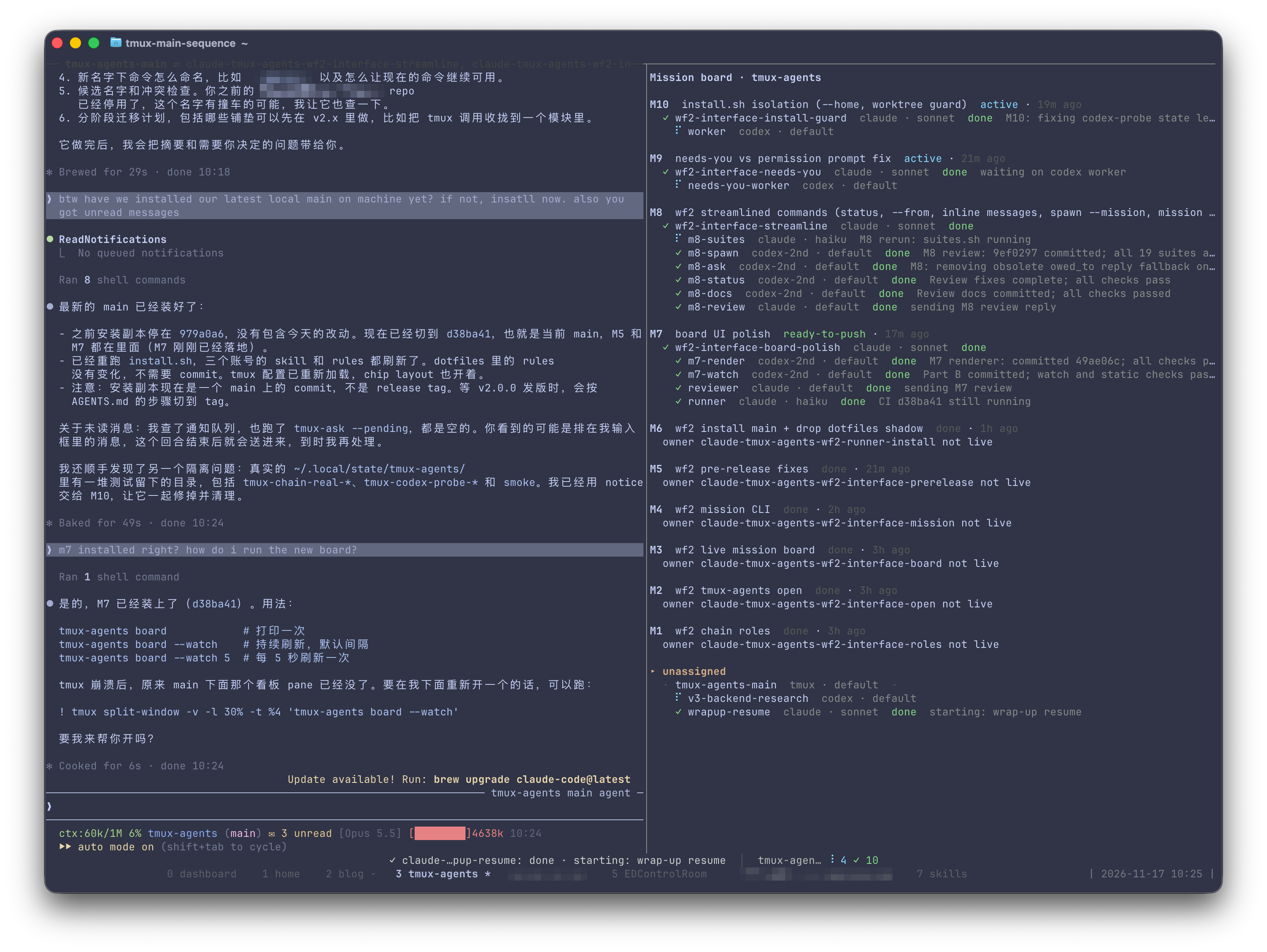
The main agent on the left, tmux-agents board --watch on the right. Click for the full size.
I'm rebuilding how my tmux-agents team works. The old main → secondary → worker chain burned most of its tokens on a secondary that never cleared its context and got the most messages: on the tmux-agents project alone, the secondary used 143M tokens to the main's 91M. Now there is one Opus main that only talks to me and decides, a short-lived Sonnet interface per mission that hands out the work, reviews it and lands it, then closes, plus Codex workers, Opus reviewers and Haiku runners for tests and CI.
Each mission is a record managed with tmux-agents mission, shared across worktrees, and tmux-agents board --watch is a live, read-only pane that groups every agent under its mission with its model, state and progress. One glance and I can see the whole team.
It's part of a bigger push to trim the fat. A fresh Claude session used to spend about 50k tokens before I typed anything; after measuring and cutting unused tools, MCP servers and hidden skills, it starts at about 16k. And I wrap up, then clear far more often, so no agent drags 150k of scrollback through every request.
All of it is coming soon: role-based spawning, mission records, the board and a single tmux-agents status command will ship together as tmux-agents v2.0.0, with posts on the new team flow and on where my Claude tokens actually went.
I released v1.12.0 of my skills. The error-boundary rule in engineering-standards now says that when a boundary normalises a failure, it keeps the diagnostics that failure needs, in logs or error metadata as the boundary chooses. Intentional cancellation counts as lifecycle control, not a request failure the user has to handle. Typed errors owned by each layer stay as they were, and the rule still doesn't prescribe how to surface underlying errors, a universal cancelled case or a logging implementation.
I shipped v1.24.1 of tmux-agents to correct the digest's reading command to tmux-notes --all --keep-unread and tighten up recovery after clearing an agent's context. A short resume phrase restores the existing chain role, using a temporary, never-committed HANDOFF.md to choose what to continue. The main agent also checks and updates the new session's resume ID in main-sequence, waiting for Codex to finish its first turn before recording it. All 68 offline test suites, seven PR CI checks and the required probes on two Codex accounts passed; I've updated the local installation and status chip.
I released v1.11.0 of my skills. engineering-standards now has rules for what crosses a boundary: no enum that only mirrors domain cases to serialize them, a wire-format value only when it is a deliberate choice, named payloads when several values travel together, members grouped by responsibility in Swift's order, and a test rule to assert the final wire output. wrap-up now offers numbered choices for what to keep before a session clear, and parks the picked context in a local, uncommitted HANDOFF.md so the next session picks up where this one stopped.
I shipped v1.24.0 of tmux-agents, which adds quiet notes for the chatter between agents that doesn't need to interrupt anyone. tmux-ask --note leaves a note instead of pasting a prompt, and tmux-notes reads them with one read cursor per receiver; Claude gets an unread summary through its prompt hook and Codex checks at turn start. After five minutes idle (configurable), an agent gets a digest that continues from the last update until I speak, bare tmux-notes --count feeds status lines, and the "stopped without replying" reminder now arrives as a quiet note. The agent-chain rules also spell out what stays a reply, a request or a notice.
I released v1.9.0 of my skills. Every item in a design-lab gallery now has a short, stable ID in a chip with a Copy ID button, and each round's landing page lists every item with its ID. When the phone blocks the clipboard, the chip's text is selected and the page says "Selected, copy it". It came out of reviewing social preview cards from my phone, where pointing at "the third Glass card, the dark one" got old fast; now I paste C3-glass-series-dark back and the agents know exactly which one I mean.