Codex Brain, Claude Harness: Running GPT-6-Astra in Claude Code
Part of a series
- AI-Assisted Engineering Series (17 of 17)
I got a good deal on a Codex plan this month. Codex is already my main worker, but most of my day happens in Claude Code: its harness, its permission modes, my skills and hooks, and the way I run agents with tmux-agents. So I wanted to try the Codex models there too.
There's a second reason. I want to see how much the harness matters. Same model, different harness: does GPT-6-Astra feel different in Claude Code than it does in Codex? The only way to find out is to use it for a while.
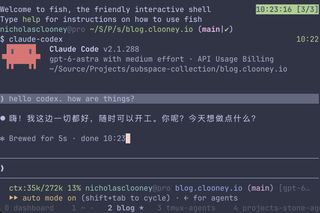
Now I type claude-astra and get Claude Code running on GPT-6-Astra.
How it works
Claude Code can talk to any endpoint that speaks the Anthropic Messages API. You point ANTHROPIC_BASE_URL at it and give it a token.
CLIProxyAPI is an open-source proxy that does exactly that. It signs in with my Codex account, serves an Anthropic-style API, and translates each request into a call on my Codex subscription. I run it in Docker on my Mac, pinned to v8.0.27, and it only listens on localhost.
Apart from the API key, the proxy runs on its default config.
The commands
The rest is six small fish functions in my dotfiles:
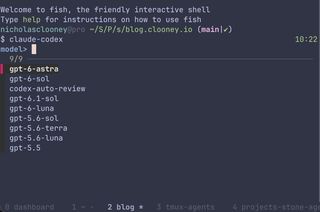
claude-astrastarts Claude Code on GPT-6-Astra.claude-codexlists the models the proxy serves and lets me pick one with fzf.claude-proxy MODELis the base both of them use.cliproxy-urlandcliproxy-modelsprint the proxy's address and its models.secret NAMEreads one secret from a local env file that 1Password provides.
claude-proxy is where everything happens:
The proxy needs an API key, and the functions never contain it. secret reads it at launch from an env file that 1Password provides, so the key only lives in 1Password. That's what makes it safe to commit these functions to a public repo.
The key is also only set for the claude process, through env, so it doesn't leak into my shell.
Two settings that matter
The context window. Claude Code doesn't know these models, so it assumes a 200k window. GPT-6-Astra actually has 272k, so claude-proxy sets CLAUDE_CODE_MAX_CONTEXT_TOKENS to match. On my Pro plan the gpt-5.6 models get 921k, so they get their own branch.
Effort. Claude Code lets you set effort per model in settings.json. I set GPT-6-Astra to medium, which is what the screenshot shows.
How it came together
I didn't write any of this. The agent chain in the private repo where the proxy lives did, a main agent, a secondary and a Codex worker, from a series of my requests:
- Set up CLIProxyAPI as a pinned, git-tracked Docker Compose stack.
- Give me a
claudecommand I can copy and test. - What's the easiest way to start on GPT-6-Astra?
- Don't hard-code the model so many times, just once.
- Keep the key in 1Password, without hard-coding the link between the env file, the proxy and Claude.
- I still want
claude-astra, so pull the generic part ofclaude-codexinto a base. - Save it all into my dotfiles.
Each request reshaped the functions a bit. That last step crossed projects. My dotfiles have their own chain, so the proxy project's secondary sent one request to the dotfiles secondary, the same secondary-to-secondary rule from my last post. The dotfiles secondary added the six functions, checked that none clashed with existing ones and that the env file stays out of git, and smoke-tested them in a fresh shell. Then it committed them.
Building our own anyway
Before settling on fish functions, the worker sent two sub-agents to survey what already exists. They compared 14 launchers and model switchers for Claude Code. One of them, melonamin's claudex gist, is very close to what we built: fish, CLIProxyAPI, a claudex command.
The verdict was to keep our own and borrow ideas, rather than switch to one of them. So ours stayed ours, even though it's similar.
A cautionary tale about auto-approve
My agents run with automatic approvals. While moving the proxy to its localhost port, one of them cleaned up with an rm and deleted my real config.yaml. The API key in it was gone.
This time the blast radius was tiny. The only thing I'd changed from the default config was the key, and that lives in 1Password. Nothing was in production, and nothing got hurt. The agent apologised and saved a note to itself never to do that again.
But it's a reminder of what automatic approval means: the agent can delete files without asking. It's worth thinking about what's within reach before you turn it on.
What's missing
Running Codex in Claude Code isn't the same as running Claude in Claude Code. Two things I use a lot are missing:
- Artifacts. Claude can publish a page I can open on my phone. That doesn't work here.
- Claude in Chrome. Claude drives my browser through its Chrome extension. Codex can probably operate Chrome too, but it would need something else to drive it.
What's next
The setup is done. Now the real experiment starts: using the same model in two harnesses, and seeing where it feels different. I'll write that up once I've lived with it.